


Why One Overhead Light Leaves a Room Cold
Autumn evenings arrive early and then stretch out. By half past four the light has gone, and the instinct is to hit the big switch on the ceiling and flood the room. It is the quickest thing to do and the least hospitable. A single pendant in the middle of a ceiling lights the centre of the floor, leaves the corners in shadow, flattens the texture out of wool, linen and old wood, and puts anyone sitting beneath it in an unflattering wash from above.
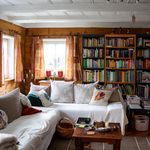
Vintage rooms were never lit that way. Before electricity, a room was lit by whatever flame happened to be nearest — a candle on the mantel, an oil lamp on the table, a fire in the grate. What you got was a series of small, unequal pools of light with warm dimness between them, and that is exactly the effect worth recreating. It costs nothing like a rewire either. The trick is layering: several lights at different heights doing different jobs, so the eye travels around the room and the shadows feel intentional rather than neglected.
Start Low with a Floor Lamp or Two
A floor lamp is the anchor of a layered scheme. Stand it beside a sofa or armchair rather than tucked in a corner behind the furniture, so the light falls over your shoulder and onto a book instead of straight down over your head. Height matters more than people expect: the shade should sit at roughly eye level when you are seated, about 100–120cm from the floor, so you are never looking up into the bulb.
- A standard lamp with a plain linen or softly pleated shade throws a generous upright glow and warms a whole end of the room.
- A sprung task lamp, angled downwards, is perfect beside a reading chair and gives you a bright pool exactly where you need it.
- A rattan, wicker or slatted wooden shade scatters light in stripes across the wall and ceiling, which looks wonderful with old plaster.
- If the room is long, use two floor lamps at opposite ends. One alone makes the space lean to one side; two balance it and give the eye somewhere to travel.
Table Lamps at Eye Level and Below
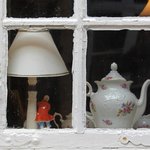
Two or three small lamps will always beat one large one. Think in terms of side tables, window sills, a sideboard at the back of the room, even a stack of books on the floor. Aim for a mix of heights — roughly 30cm, 45cm and 60cm tall — so the bright points step down across the room instead of sitting in a straight line. A small lamp on a sideboard is especially useful, because it lights the far wall and gives the room depth.
- A compact ceramic or aged brass lamp with a 20–25cm shade is ideal on a side table beside an armchair.
- An opaline or frosted glass shade gives a soft, milky glow that flatters skin tones and looks lovely on a dark evening.
- A tiny lamp on a bookshelf or windowsill adds a quiet point of interest at the edge of your vision.
- Keep shades pale and plain if you want light, darker or patterned if you want atmosphere. Both have their place.
Candles, Warm Bulbs and the Small Details
Candles are not merely decorative. They give a moving, low-level light source that nothing electric quite matches, and the flicker is what makes a room feel inhabited. Group them at odd heights: tall candlesticks on the mantel, a cluster of tea lights in a thick glass, a pillar candle in a shallow dish on the coffee table. Trim wicks to about 5mm so they burn cleanly, keep them away from curtains and soft furnishings, and never leave them unattended.
The bulb itself matters as much as the fitting. Look for warm white, somewhere between 2200K and 2700K, and avoid anything labelled cool white or daylight, which will undo all your good work in a single flick. Choose dimmable bulbs of around 40–60W equivalent rather than 100W; you want glow, not glare. A visible filament bulb in an open fitting looks charming, and a dimmer on the main ceiling light — or simply a lower-wattage bulb in it — means you always have the option of a soft wash rather than a stark one.
A Slow Evening, Switched On in Layers
Layering is as much a habit as a decorating decision. As the afternoon fades, put on the floor lamp first. It lifts the room without waking it up. When the light outside goes properly blue, add the table lamps, one at a time, working away from where you are sitting. After supper, light the candles and turn the overhead light off altogether.
There is something quietly anchoring about this little sequence. It marks the end of the working day, tells your body that the pace has changed, and gives you a reason to move slowly around your own home. Light only the rooms you are actually using, and leave the rest dark; the contrast makes the lit space feel smaller, warmer and more contained. Do it for a week and you will notice the difference — the evenings stop feeling like something to get through and start feeling like somewhere to settle.




John Doe
14 January, 2022Having no content in post should have adverse..
Chauffina Carr
10 April, 2022We use these tests all time! Killer stuff!
Jim Séchen
16 July, 2022Thanks for all the comments, everyone!