


Why small rooms welcome a mix of eras
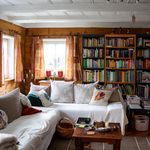
A small room is the ideal place to mix old and new, precisely because you can see everything. In a large space, a single style can drift past you unnoticed. In a box room or a narrow Victorian terrace reception, each piece is in the frame at once, so contrast reads clearly and deliberately. The risk is the opposite: a room furnished entirely from one catalogue looks like a showroom rather than somewhere a life happens.
An antique mirror or a scuffed vintage lamp brings the human layer — age, patina, a slight awkwardness that makes a space feel lived in. Modern pieces bring comfort, clean lines and, crucially, scale. The balance is what matters. You are not building a period room or a minimalist box, but a calm conversation between the two.
Let one modern piece anchor the room
Choose your largest piece — usually the sofa — as the modern anchor and let everything else respond to it. Clean lines and a low profile are your friends in a small room. Look for a two-seater no wider than about 1.7 metres, with slim arms and legs that lift the frame off the floor. Seeing the carpet or floorboards underneath buys you visual space, which matters more than actual centimetres.
Keep the anchor quiet in colour and pattern: a soft oatmeal, a warm grey, a muted linen. This is not the piece to be interesting. Its job is to be comfortable and unobtrusive, so the vintage elements have somewhere calm to land. The same principle applies to a bed or a storage unit — whichever takes up the most visual weight should be the simplest thing in the room.
Introduce vintage in one or two considered places
Resist scattering antiques about. One substantial piece reads as collected; five small ones read as clutter. Over a modern sofa, an antique or vintage mirror is close to perfect: it bounces light around a small room and adds depth where a solid wall would stop the eye. As a rough guide, the mirror should span roughly two-thirds to three-quarters of the sofa's width, hung so its centre sits at about eye level when you are standing.
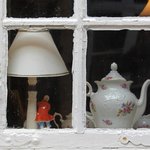
If a mirror will not work, try a vintage table lamp on a side table, a small antique chest used as a bedside table, or a single old framed print. Check proportions before you commit:
- Height: a vintage lamp base should be no taller than about 45cm on a table beside a sofa, so the shade sits below eye level when you are seated.
- Depth: an antique chest replacing a modern unit should be no deeper than 45cm in a narrow room.
- Condition: hairline cracks and faded brass are assets, not flaws. Perfect reproduction defeats the point.
Repeat one colour to tie the eras together
This is the single most effective trick for a mixed-era room, and it costs almost nothing. Choose one colour — a faded olive, an ochre, a soft terracotta, a dusty rose — and repeat it in at least three places across both old and new pieces. A modern sofa with an ochre cushion, a vintage ceramic lamp base in a similar ochre, a small print or a bowl on the shelf. The eye picks up the thread and stops noticing the decades.
Keep it to one colour. Two competing repeats pull the room apart. The shade does not need to match precisely — a family of related tones feels more natural than an exact match, which can look like a display in a shop. If you already own something with the right colour in it, build around that.
Layer the lighting for slow evenings
Lighting is where a cosy vintage interior and slow living meet. A single ceiling light in a small room flattens everything and makes the space feel smaller. Aim for three sources of light at different heights, all warm and all dimmable.
- Eye level: a vintage table lamp beside the sofa, ideally with a fabric shade that softens the glow.
- Low level: a small floor lamp or a lamp on a low stool, washing light up a wall or across the floor.
- Accent: a picture light, a candle or a small lamp on a shelf, just enough to create a pool of light.
Choose bulbs of 2700K or lower — anything cooler will fight the warmth of old wood and brass. Fit a dimmer if you can. In the evening, turn off the overhead light entirely and let the layers do the work. This one change does more for a room's atmosphere than any amount of rearranging.
Edit slowly and live with it
Slow living is not a style, it is a pace. Buy one thing at a time and live with it for a few weeks before adding the next. Keep surfaces mostly clear: one object on a side table, not four. Let the antique mirror or the vintage lamp be the star of its corner rather than one voice in a crowd.
Seasonal swaps are a gentle way to keep a small room from going stale — a heavier wool throw in winter, a lighter cotton one in summer, a different shade on the lamp. Move things between rooms rather than buying more. When you do buy, look for pieces that will age well and that you would still want in five years. A room built this way takes longer to finish, and that is exactly the point.




John Doe
14 January, 2022Having no content in post should have adverse..
Chauffina Carr
10 April, 2022We use these tests all time! Killer stuff!
Jim Séchen
16 July, 2022Thanks for all the comments, everyone!